
Home » Archive

Articles in the Energy Management Category

Energy Management, Featured, Headline »

[23 Jan 2012 | Comments Off | ]

- By Dan Steiner, PE, CEM, CDSM; President
Think for a moment about how much your facility pays annually for utilities: electricity, natural gas, etc. Now, think about taking one-fourth of an equivalent amount of money—and simply throwing it out the window!
Sure, this notion sounds crazy. But even in today’s cost-conscious world, that’s still essentially what American business does when it comes to the use of energy dollars. Recently compiled data by the Lawrence Livermore National Laboratory (www.llnl.gov) shows that nearly one-fourth of the energy consumed by U.S. commercial and industrial …

Energy Management, Featured »

[23 Jan 2012 | Comments Off | ]

A great way to start 2012 is by getting an accurate picture of your company’s energy usage and how you might become more energy efficient. And a great way to do this is with a free energy assessment currently being offered by D.L. Steiner.
D.L. Steiner’s energy assessment is a CEM-completed engineering study that uses your company’s historical energy data, an inspection of your facility, and comparisons with industry averages to identify areas where you can increase energy efficiency and conservation—and save money!
Contact D.L. Steiner at 419-222-6048 to schedule your …

Energy Management, Featured »

[23 Jan 2012 | Comments Off | ]

By Ryan Zimmerman, Electrical Engineer
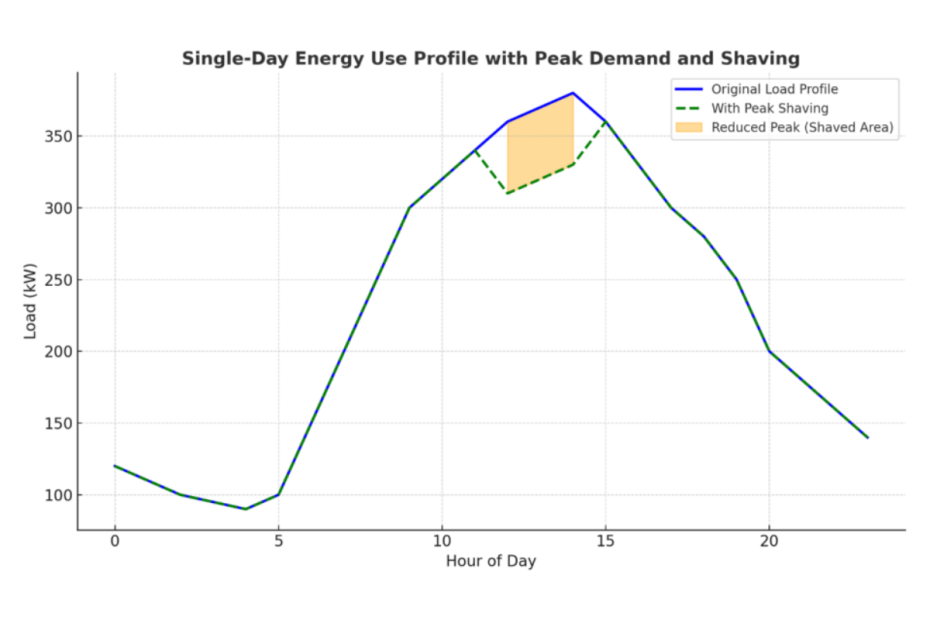
In the previous issue of the PCC Journal, we discussed how demand control can help companies lower their utility bills by smoothing out their electrical demand (the kW amount of electricity required for operations). This article looks at six great options for setting up an effective demand control program—and eliminating those costly demand charges!
Option 1: scheduled operations. Under scheduled operations, all operations are metered to determine their electrical load and then run at predetermined times, with some functions staggered so they don’t operate simultaneously. High-demand operations …

Energy Management, Featured, Headline, Predictive/ Preventive Maintenance »

[14 Jul 2011 | Comments Off | ]

Power factor and power factor correction are familiar electrical terms, but just in case they are new to you, let’s do a quick review. As it relates to electrical energy, power factor is the ratio of working power to apparent power. Working power (kW) is the electrical energy you need to do useful things, namely, run production equipment. Apparent power (kVA) is the electrical energy your utility company must supply in order to deliver the working power you need.
These two energy values aren’t the same thing, and they aren’t necessarily …

Energy Management, Featured, Headline »

[14 Jul 2011 | Comments Off | ]

With today’s focus on reducing the high cost of monthly electric utility charges, most companies automatically assume this means installing new, more energy-efficient fixtures and equipment. These can help, but for many facilities, the place to begin in cutting electric costs is not by installing a new lighting system or high-efficiency motors. Instead, it’s by taking a look at the electric utility bill—more specifically, the demand charge on that bill.
What is a demand charge? It is the amount the electric utility charges your facility for supplying electricity at the rate …

Energy Management, Headline »

[13 Jul 2011 | Comments Off | ]

Advances in digital monitoring/control devices and networking technology have expanded the range of power monitoring equipment available, plus improved its functionality. The result is a significant new potential for increasing power system reliability while decreasing system operating costs. These advances are causing a growing number of facilities to develop comprehensive energy management strategies that help them maximize their energy resources.
While most companies recognize the value of energy management, their success addressing the issue varies. Properly controlling a power system is often seen as too time consuming, inefficient, and expensive to …

Energy Management, Featured »

[31 Dec 2008 | Comments Off | ]

Modern power management systems can offer savings and more efficient operation.